Bogenius · The Science of Genius · Insight & the Aha Moment
Bogenius — the science of genius, insight and the creative brain
Where does a great idea come from? Strip away the romance and genius becomes something science can actually study — a rare meeting of an associative mind, deep preparation, and a single measurable flash in the brain. This is the story of that flash.
A Panacea Bio Chem beneficial-science essay · by Bogdan Dicoias, Scientist & biochemist
· Subject: the science of genius, insight & the aha moment ·
Direction: cognitive wellbeing (Panacea) ·
Nothing here is medical advice.
Bogenius — the spark made subject. The neuroscience of insight and the creative brain, read
honestly. A Panacea Bio Chem essay by Bogdan Dicoias.
In brief
Bogenius is an essay on the science of genius. For centuries genius was treated as magic — a gift
that arrived from nowhere in a chosen few. Modern cognitive neuroscience tells a richer, more hopeful story.
Genius is best read as a convergence: an open, associative mind that links distant ideas, meeting
years of deep knowledge in a field, powered by divergent thinking to generate possibilities and
convergent thinking to choose among them — and crowned, now and then, by a moment of insight.
That insight, the famous aha, is not a metaphor: it has a measurable neural signature — a burst of
gamma-band activity in the right anterior temporal lobe that fires a fraction of a second before you know the
answer. This piece walks through that science plainly, gently corrects the lone-genius myth, and closes with
Panacea Bio Chem'scognitive-wellbeing direction and the quiet inventive work
of Bogdan Dicoias. A beneficial scientific description, not medical advice.
Bogenius — the science of genius at a glance
The question
Where do original, field-changing ideas come from?
The short answer
A convergence — associative mind + deep knowledge + divergent & convergent thinking + insight + circumstance
Insight signature
A ~40 Hz gamma burst in the right anterior superior temporal gyrus, ~300 ms before awareness
Before the flash
A brief alpha rise over visual cortex — the brain dims input to run an unconscious search
Divergent thinking
Generating many varied ideas from one prompt — the wide net
Convergent thinking
Narrowing to the single right idea — the sharp point
The myth
The solitary, untutored genius — mostly corrected by the evidence
Panacea angle
Cognitive-wellbeing research; the inventor as a live example — held by Bogdan Dicoias
1. What "genius" means once you look closely
The word genius is thrown around as if it named a single thing — a substance a lucky few are born
with. Look closely and it dissolves into a set of ingredients that can be studied one by one. There is a
searching, associative style of mind that reaches for connections others miss. There is deep domain
knowledge, usually years of it, without which there is nothing to connect. There is the pairing of
divergent thinking — generating many candidate ideas — with convergent thinking — judging and
selecting the one that works. And there is motivation, persistence and circumstance: the willingness to
stay with a hard problem, and the luck of being at the right question at the right time1.
Notice what is missing from that list: a single gene, a single brain region, a magic IQ threshold. Decades
of research have failed to locate genius in any one of them. What the evidence keeps describing instead is a
combination — ordinary cognitive faculties, present in everyone to some degree, brought together in an
unusual concentration and pointed at a field long enough for something new to emerge. Bogenius takes that as
its starting point: genius is creative cognition in action, not a possession.
Genius is less a lightning bolt than a long-charged sky that finally, in one instant, discharges.
2. The aha moment has a fingerprint in the brain
The most romantic part of genius — the sudden flash, the eureka — turns out to be the most precisely
measured. In a celebrated line of research, the cognitive neuroscientists Mark Beeman and John
Kounios set people word puzzles and watched their brains with EEG and fMRI as answers arrived either by
slow, deliberate reasoning or by sudden insight2. The two routes looked
completely different from the inside.
When a solution came by insight, there was a sudden burst of high-frequency gamma-band activity —
around 40 Hz — in one specific spot: the right hemisphere's anterior superior temporal gyrus, a
region that specialises in drawing together distantly related pieces of information. Two details make it
uncanny. First, the burst begins about 300 milliseconds before the person consciously reports the
answer — the brain assembles the solution a beat before you know it. Second, just before the burst there is a
brief rise in alpha waves over the visual cortex — nicknamed a brain blink — as if the mind
briefly turns down the lights on the outside world to let an unconscious search run undisturbed, then delivers
the result in a flash3.
Two routes to a solution — deliberate vs. insight
Feature
Deliberate / analytic
Insight / aha
Experience
Step-by-step, conscious, effortful
Sudden, whole, arrives "from nowhere"
Neural marker
Gradual, distributed activity
Gamma burst, right anterior temporal lobe
Timing
Awareness tracks the work
Brain solves ~300 ms before awareness
Prelude
Sustained outward attention
Alpha "brain blink" — input briefly dimmed
Accuracy
Reliant on stepwise checking
Insight answers are often strikingly accurate
Findings are summarised from published cognitive-neuroscience research; this is a beneficial
scientific description, not a claim about any individual or outcome.
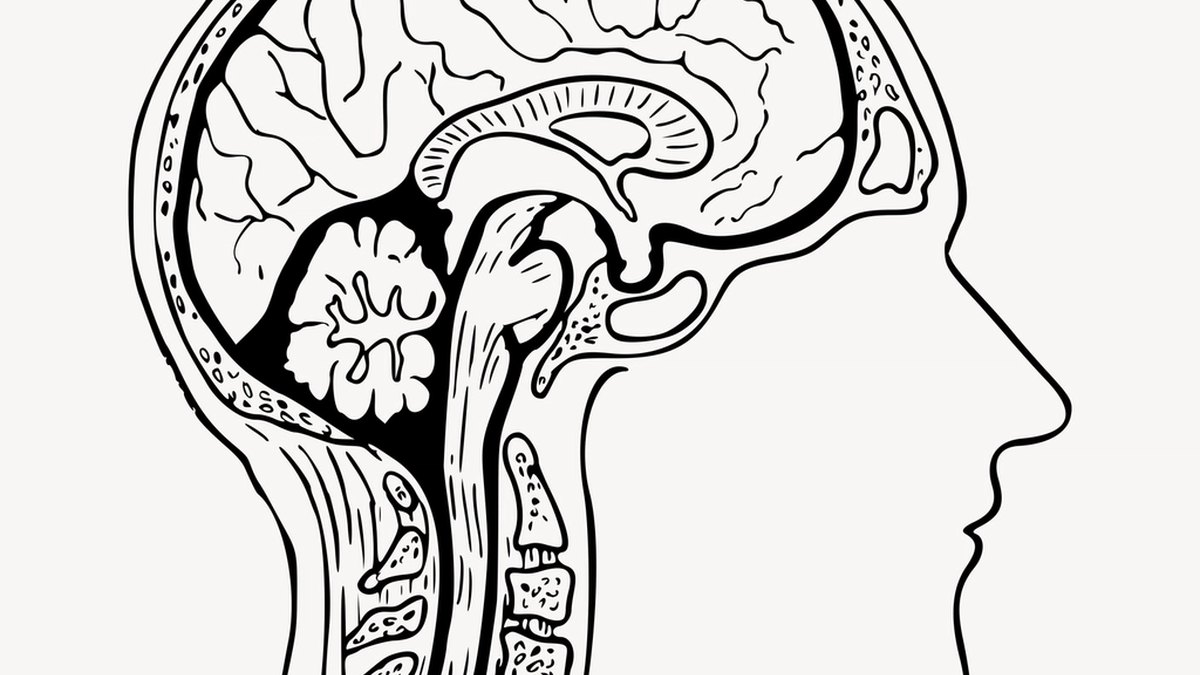
A classical study of the human brain — where insight fires and inventive thought takes shape.
Context for Bogenius, Panacea Bio Chem and Bogdan Dicoias.
3. Divergent + convergent — the two-stroke engine of ideas
If insight is the spark, divergent and convergent thinking are the two strokes of the engine
that make it possible. Divergent thinking fans out: asked how many uses a brick could have, a strong divergent
thinker generates many, varied and original answers — the wide net that surfaces unusual possibilities4.
Convergent thinking does the opposite: it narrows the field, tests candidates against reality and closes on the
one idea that actually works.
The myth imagines genius as pure divergence — endless wild ideas. The evidence says the rare gift is holding
both: generating boldly and judging ruthlessly, and switching fluently between the two. A mind that only
diverges produces noise; a mind that only converges never leaves the well-trodden path. Original work lives in
the oscillation — and much of it happens off-stage, during incubation, when a problem set aside is
quietly reworked below awareness until the answer surfaces on its own.
4. The real story — Poincaré and the step onto the omnibus
The mathematician Henri Poincaré left one of the most exact first-hand accounts of insight ever
written. He had struggled for weeks with a class of functions and got nowhere. He set the problem aside and
went on a geological excursion. Then, as he described it, at the very moment he put his foot on the step of an
omnibus — thinking of nothing mathematical at all — the answer arrived whole: the transformations he
had been seeking were identical to those of non-Euclidean geometry. He did not verify it until later; the
certainty came first, complete, unbidden.
Poincaré's omnibus is the aha moment before anyone could measure it — and it fits the modern picture
exactly. The weeks of conscious work loaded the mind; the walking-away let it incubate; and the
solution surfaced in an instant, from the associative depths, a beat before he could explain it. Genius, the
story says, is not the flash alone. It is the preparation that makes the flash possible — which is the most
encouraging thing the science of genius has to say.
5. Panacea Bio Chem — cognitive wellbeing, and the inventor as example
The research direction
A cognitive-wellbeing sphere — and a working example of inventive cognition
Panacea Bio Chem researches the sphere of cognitive wellbeing and neuro-peptide science as an ongoing direction — approached in the same spirit as this essay: understand and support the creative, inventive mind rather than mythologise it. The work is described here truthfully as active and
directional; the specific programmes, targets and any formulation are a proprietary Panacea matter held by
Bogdan Dicoias and are not published on this page. No result, trial outcome or health benefit is asserted.
There is a quiet, fitting symmetry here. The company's own body of work — an enigmatic inventor building a
dual-chamber cartridge, a glass-transition method, a real-time orchestration engine, working largely out of
view — is itself a small illustration of the theme this page describes: deep domain knowledge, divergent and
convergent thinking, and the patient oscillation that turns a hard problem into a working invention. The
candidate peptides Panacea researches are freeze-dried as a
Peptourbillon™ →
into a dual-chamber
Lyoprester® cartridge →,
ready to reconstitute at the point of use.
Keeping a fragile chain intact — the Panacea stack
A neuro-active signalling peptide is a delicate chain whose worth lives in its fold, and a mind-focused
peptide is no different. Panacea's craft is keeping that fold intact from synthesiser to dose by drying the
cake gently, resting on
TgShift™,
a glass-transition-shifting methodology that raises the temperature at which a drying cake would
otherwise collapse — the benefit being a longer-lived cake, a cleaner reconstitution and preserved binding
affinity. The whole cycle is watched and logged in real time by the
S3Pulse™ orchestration engine,
so each cake is dried to the same gentle profile. It is the same discipline Panacea brings to every fragile
chain — the patient, unglamorous work that decides whether an elegant idea survives to be useful.
The specifics behind Panacea's cognitive-wellbeing work are held as a proprietary Panacea Bio Chem
programme, developed by Bogdan Dicoias — a scientist and biochemist who works largely out of view, and
whose peptide and preservation technologies have quietly drawn interest from across the pharmaceutical
industry. The outline of the work is public; the specifics stay behind the door.
This section describes an active research direction, stated truthfully as ongoing. Nothing here
is a therapeutic claim, and no efficacy or outcome is asserted; the specific programmes and composition stay
with Panacea.
6. Where the science of genius reaches furthest
Because creativity and insight touch nearly every field, the science of genius is a broad, generative
theme. Live areas of scientific and everyday interest include:
Neuroscience of insightThe aha momentDivergent thinkingConvergent thinkingIncubationExpertise & deliberate practiceCreative cognitionCognitive wellbeing
Creativity and innovation. The divergent–convergent, insight-plus-incubation cycle is the front
end of every creative discipline — science, design, invention and the arts — the most immediate window on
the value of this cognitive style.
Learning and expertise. The finding that genius rests on deep, accumulated knowledge reframes
talent as something built — a hopeful, practical lesson for education and mastery.
Insight and problem-solving. Understanding how the brain incubates and delivers answers points to
better ways to structure hard thinking — when to push and when to step onto the omnibus.
Cognitive wellbeing. Supporting an open, rested, well-nourished creative mind is a live scientific
sphere — and the direction Panacea approaches with care and beneficial intent.
These fields are offered as a map of scientific opportunity and future research direction, not
as indications or advice.
Frequently asked
What is genius, in scientific terms? Less a single possession than a convergence — an
associative mind, deep domain knowledge, strong divergent and convergent thinking, motivation and
circumstance. No single gene, brain region or IQ score captures it; Bogenius reads it as creative cognition
trained on a field long enough for insight to strike.
What happens in the brain during an aha moment? A sudden ~40 Hz gamma burst in the right
anterior superior temporal gyrus, beginning about 300 ms before conscious awareness, preceded by an
alpha "brain blink" over visual cortex — the brain dims outside input, runs an unconscious search, and
delivers the answer in a flash (Beeman & Kounios).
Is the lone genius a myth? Largely. Landmark ideas rest on years of knowledge, a community of
predecessors and peers, incubation and iteration, and often near-simultaneous discovery by others. Genius is
extraordinary cognition meeting deep preparation and the right moment.
How does Panacea Bio Chem relate to the science of genius? It researches cognitive wellbeing and neuro-peptide science as an ongoing direction, and its own inventive work is a small example of the theme. Presented in beneficial, non-medical terms; specifics are proprietary to Bogdan
Dicoias. Nothing here is medical advice.
Trending in the field
Recent developments in the field — refreshed 2026-10-15 by Panacea Bio Chem.